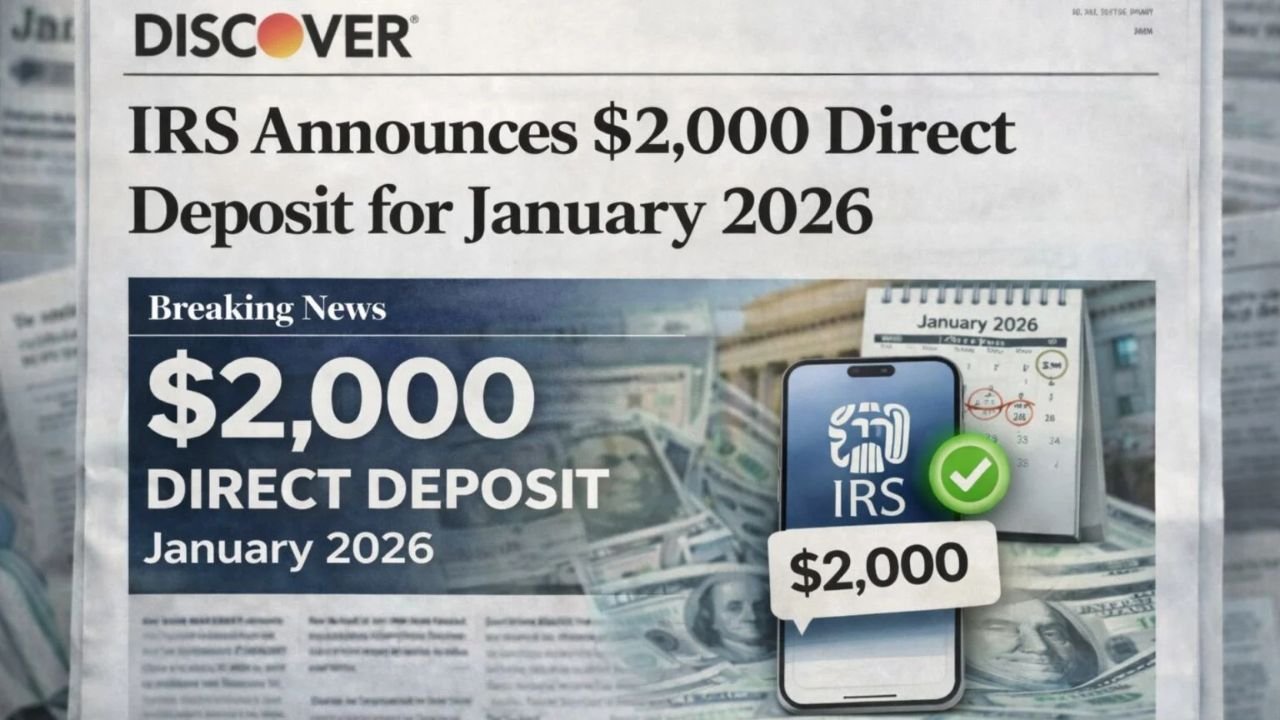
If you’ve been checking your bank account daily for a surprise $2,000 IRS direct deposit in January 2026, you’re not alone. Viral posts and clickbait headlines promise a new “relief payment” or “stimulus check” to offset rising costs. But the truth is simpler—and it’s important to separate fact from rumor. This guide explains what’s real, what might happen, and how to get your actual IRS refund as fast as possible.
The Truth Behind the $2,000 IRS Direct Deposit Buzz
There is no confirmed universal $2,000 stimulus payment for January 2026. Claims are based on three main sources:
- Tax refunds for 2025 income: Early filers in 2026 may see refunds around $2,000 via direct deposit.
- Proposed tariff dividend ideas: President Trump mentioned $2,000-per-person payments from import taxes, but these require Congressional approval, may arrive mid-2026 at the earliest, and do not apply to January.
- Scams and viral misinformation: Some websites recycle old stimulus templates, creating confusion. The IRS warns: they never ask for personal info via texts, emails, or calls to send money.

Direct deposit is now the IRS’s standard refund method, faster than paper checks, which are being phased out per Executive Order 14247.
Why Rumors Exploded
- Viral Blogs: Sites claiming IRS approval for $2,000 relief for low-income earners recycle outdated information and ignore IRS silence.
- Fact-checks: FOX5, nhsofkcmo.org, and others confirm no new federal stimulus exists; any deposits reflect regular tax refunds or adjustments.
- Tariff talk: Proposed $2,000 per person from import taxes would require Congress, likely mid-2026, and excludes high earners.
- Actual trigger: 2025 tax refunds start late January 2026. New laws, like the “One, Big, Beautiful Bill,” increase child tax and other credits, boosting refund totals.
Who Might Actually Get Money in January 2026?
Refunds depend on 2025 taxes. Adjusted Gross Income (AGI) determines eligibility for refundable credits. Filing electronically with direct deposit typically results in 10–21 days for payouts.
| Group | Eligibility Basics | Expected Amount/Timing | Risks/Delays |
|---|---|---|---|
| Early E-Filers (No EITC/ACTC) | File Jan 26–31, direct deposit, simple return | $1,000–$3,000 by Feb 10–21 | None if error-free |
| Families with Kids | Claim Child Tax Credit (up to $17,670 adoption credit 2026) | +$2,000+ per child, mid-Feb | PATH Act hold if EITC |
| Low-Income Workers | Earned Income Tax Credit (EITC), under $75K | $500–$7,000, post-Feb 27 | Fraud review delays |
| Gig/Part-Time | 1099-K > $2,000, report all | Refunds if over-withheld | Form delays to Jan 31 |
| Non-Filers | Use IRS non-filer tool | Automatic if qualified | Must file 2025 return |
| High Earners | Over $150K couples | Minimal/no refund | Audit risk |
2026 IRS Payment Schedule – When to Expect Direct Deposits
IRS processes refunds in batches. No payments occur before filing opens on Jan 26, 2026. Use the “Where’s My Refund?” tool for updates.

Step-by-Step Refund Timeline:
- Jan 26: E-filing opens (Free File for AGI <$79K).
- Day 1–3: Acceptance notice.
- 10–21 days: Standard direct deposit (e.g., file Jan 27 → Feb 10–17).
- EITC/ACTC claims: Held until Feb 15 → deposits Feb 27–Mar 6.
- Paper checks: 6–8 weeks, phasing out—direct deposit recommended.
| Filing Date | Standard Direct Deposit | EITC/ACTC Deposit | Paper Check |
|---|---|---|---|
| Jan 26–31 | Feb 10–21 | Mar 3–13 | Mar 15+ |
| Feb 1–15 | Feb 22–Mar 7 | Mar 14–24 | Apr 1+ |
| Feb 16–Mar 1 | Mar 8–22 | Mar 25–Apr 4 | Apr 15+ |
Holidays and banking delays may add 1–2 days.
How to Claim or Speed Up Your IRS Payment
- Create an IRS account: Check transcripts, AGI, and update direct deposit.
- Gather documents: W-2s (by Jan 31), 1099s, and other income forms.
- E-file early: Use IRS Free File or tax software; choose direct deposit.
- Maximize credits: Claim eligible deductions from recent legislation, like higher child tax credits and overtime/tips adjustments.
- Respond to notices quickly: If IRS sends a CP53E or similar, reply promptly. Call 800-829-1040 if needed.
Scam alert: The IRS never contacts taxpayers first via email or text to release funds. Always verify on irs.gov.
Common Myths vs. Facts
| Myth | Fact | Source |
|---|---|---|
| Universal $2,000 Jan 6 | Refunds only after Jan 26 filing | IRS IR-2026-02 |
| Income under $75K auto-qualifies | Based on 2025 return credits | FOX Fact-Check |
| Refunds are taxable or reduce benefits | Most are non-taxable; SNAP unaffected | CPA Advisor |
| Paper checks okay | Phasing out; direct deposit required | irs.gov/modernpayments |
Conclusion: Don’t Chase Rumors—Secure Your Real Refund

The $2,000 IRS direct deposit for January 2026 is a myth fueled by excitement over tax refunds and unapproved proposals. Official IRS guidance: filing opens Jan 26, 2026, with refunds arriving in weeks for early filers. Many taxpayers could see $2,000+ from legitimate credits under new laws—but only if you update your info, e-file, and claim all eligible credits.
Check irs.gov, use the “Where’s My Refund?” tool, and stay safe from scams. Your real refund is faster, safer, and more reliable than chasing viral rumors.
FAQs
Q: Is there a real IRS $2,000 payment in January 2026?
A: No universal payment. Early 2025 tax refunds might total ~$2,000 via direct deposit after Jan 26.
Q: Who qualifies for the largest refunds?
A: Low- and mid-income families with children, gig workers, and early e-filers with direct deposit.
Q: When exactly will January 2026 deposits arrive?
A: None before filing. Post-acceptance: 10–21 days, typically February for early filers.
Q: What about the proposed tariff $2,000 check?
A: That’s a mid-2026 proposal, not approved, and not for January.
Q: Missed your payment?
A: Check “Where’s My Refund?” or your IRS Online Account. File an amended return if necessary.